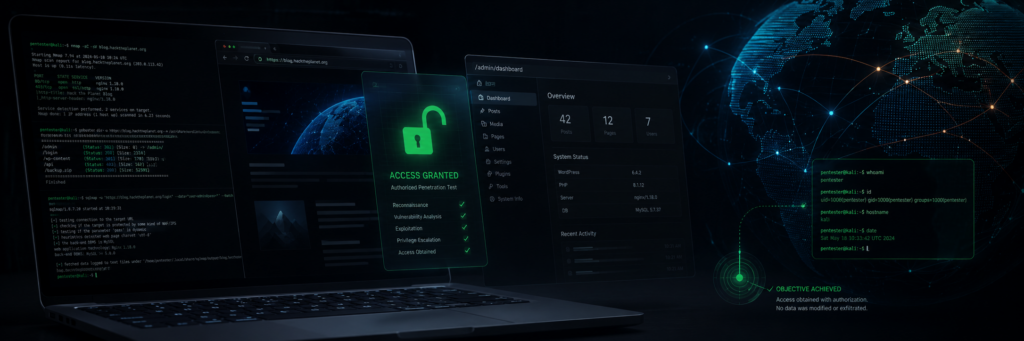
Well, someone hacked the planet. Or, more precisely, someone hacked Hack the Planet. Luckily it was a friend who had read about the vulnerability while I was engaged in some family time. He hacked it, and then he patched it, and then, because I have good friends, he wrote up exactly how he did it so the rest of us could learn from my mistake. His guest post is up here, and you should read it before or after this one. It is a better technical writeup than I would have given you, mostly because I was the target and not the operator this time.
Let me sit in that for a second, because it is uncomfortable and it should be.
I have spent twenty-nine years in this industry. I have delivered more executive briefings than I can count on exactly this kind of thing. I have walked into SOCs and watched alerts pile up unread, and I have written on this very blog about how best practices are rarely practiced and how the fundamentals are the fundamentals for a reason. Patch your systems. Know your assets. Reduce your attack surface. I know the sermon. I wrote the sermon. I can be preachy…
And my site sat unpatched for two days on a critical with a working exploit in the wild, because I was unaware and living my life.
That last part is the part I actually want to talk about, because “just patch faster” is true and useless in equal measure.
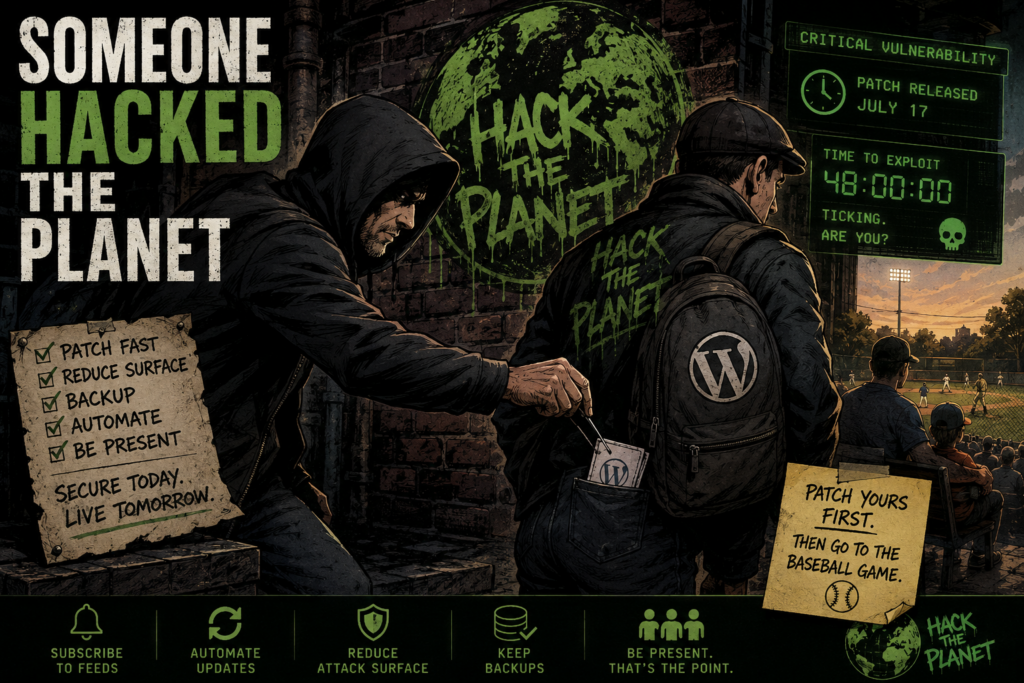
Here is what happened, and my friend lays out the timeline better than I will. WordPress shipped the fix on 17 July. A public proof-of-concept existed about a day later. He was in on day two. At no point in that timeline was I outsmarted. I was out of position. There is a difference, and the difference is the whole point. The vulnerability did not require a genius to exploit (my friend is brilliant though). It required a calendar. The patch dropped, the clock started for everyone at the same instant, and I lost the race because I was at a dinner table instead of a dashboard.
This is the trend that has been eating our field alive for years, and it is getting worse. The window between “patch is public” and “exploit is public” used to be measured in weeks. Then days. Now, increasingly, hours. When a fix ships, it ships to the defenders and the attackers at the same moment, and the attackers have a structural advantage. They only have to win faster than a defender can discover and get approval to patch the vulnerability.
Now add AI to that timeline. I want to be careful here, because the exploit that got me was not some novel machine-generated superweapon. It was a garden-variety patch-to-PoC sprint that we have seen a hundred times. But the step in that sprint that used to require real skill and real hours, diffing the patch and building a working exploit from it, is exactly the kind of task that AI is getting frighteningly good at compressing. Things that used to take a skilled researcher an afternoon are starting to take a moderately clever person with the right tooling a coffee break. AI did not invent the patch race. It is pouring gasoline on it. The trend was already bad. The accelerant is new.
So the defensive requirement is speed. Hear about the fix fast, act on it fast, beat the scanners to your box. My friend lays out the playbook in his post and it is correct. Subscribe to the right feeds, turn on automatic updates, keep good backups, know your manual override, know your stopgap. None of it is complicated. I could have written it in my sleep. I have written it, in various forms, for years.
Here is the part the sermon always leaves out.
The speed the threat demands and the speed a human life allows are not the same speed. I was not ignoring my responsibilities. I was fulfilling different ones. I was present with my family, which is the thing this entire career is supposed to be in service of, and while I was present, a patch dropped and a two-day clock started and I never heard it tick. That is not a discipline failure. It is a physics problem. There are more critical patches, dropping faster, with shorter fuses, than any individual human can personally track while also being a person.
We do not talk about this honestly enough, and it burns people out. We tell practitioners to stay current as if staying current were a matter of willpower, and then we act surprised when they are exhausted, when the home lab goes dark, when the side project blog sits two days behind on a patch because its owner was being a father instead of an administrator. The always-on expectation is not sustainable, and pretending it is does not make it so. I say this as someone who preaches the fundamentals and just got caught by them.
So what is the actual answer? It is not “try harder.” It is “need less.”
The most resilient thing I took away from getting popped is the least glamorous. Reduce what has to be defended in the first place. My friend makes this point sharper than I will in his post, and he is right. This blog is, at the end of the day, some pages of text I wrote for people to read. It does not need a database, a REST API, and a PHP runtime standing guard over a pile of essays. The machinery I was running had an attack surface that my actual content did not require. The bug that got me had somewhere to live because I gave it a home.
That is the reframe. The way you win a race you cannot personally run fast enough is to stop entering it. Automate the patching you can. Cut the attack surface you do not need so there are fewer clocks ticking in the first place. Build backups so a bad day is an inconvenience and not a catastrophe. The goal is a setup where being a human being for two days is survivable, because the machine held the line while you were gone.
I got lucky. My attacker was a friend who patched the hole and sent me notes. The next one will not be, for me or for you. Take the free lesson I paid for. Subscribe to the feeds, turn on the auto-updates, cut the surface you are not using, and then go be present with your people, knowing you built a thing that does not need you standing over it every hour of every day.
Reduce your attack surface. Patch what you can. And do not forget to spend time with the people who make all of this worthwhile, and worth fighting for.
Hack the Planet!